The Autonomous Supply Chain: How AI, Blockchain, and IoT Are Reshaping Global
The supply chain industry is undergoing a paradigm shift as artificial intelligence,

The Autonomous Supply Chain: How AI, Blockchain, and IoT Are Reshaping Global Logistics by 2030
Introduction: The Invisible Revolution in Global Supply Chains
For decades, global supply chains operated on a linear, reactive model: raw materials moved to factories, products traveled across oceans, and goods sat in warehouses until a retailer placed an order. Disruptions were handled after they occurred. But the past few years have exposed the fragility of that approach—from port congestion and semiconductor shortages to the sudden shifts in consumer demand during the pandemic. Today, a quiet revolution is underway.
Supply chains are evolving from static, step-by-step processes into intelligent, predictive, and autonomous networks. This transformation is driven by the convergence of eight key technologies: artificial intelligence (AI), machine learning (ML), blockchain, the Internet of Things (IoT), robotics, predictive analytics, 3D printing, and drones. The economic pressure to adopt these innovations is mounting. Rising labor costs in developed economies, consumers demanding faster and more sustainable delivery, and the need for resilience in the face of geopolitical shocks are forcing companies to rethink every link in their logistics chain.
Market projections confirm the momentum. According to industry reports, the AI in supply chain management market is expected to grow substantially between 2024 and 2030, with compound annual growth rates exceeding 20% in some segments. But the true innovation is not in any single technology—it is in how they combine to create a self-optimizing system. An autonomous supply chain can detect a disruption, reroute shipments, adjust production schedules, and even trigger 3D-printing of spare parts—all without human intervention.
Yet this vision is not without hurdles. Data interoperability remains a critical bottleneck: legacy systems, proprietary formats, and siloed databases often prevent seamless communication between AI, IoT sensors, and blockchain ledgers. Energy consumption, particularly from computing-intensive AI models and blockchain validation, also raises sustainability concerns. As we approach 2030, the industry must balance efficiency with transparency and environmental responsibility.
[IMAGE: A global map with glowing node points connected by digital lines, representing a real-time supply chain network.]
---
Data as the New Oil: AI and Predictive Analytics Driving Decision-Making
If data is the new oil, then AI is the engine that refines it into actionable intelligence. In supply chain management, artificial intelligence strengthens decision-making across the entire life cycle—from demand forecasting and inventory optimization to route planning and warehouse management.
Consider demand forecasting. Traditional methods relied on historical sales data and seasonal trends, but they struggled to account for sudden shifts like a viral product launch or an unexpected weather event. Machine learning models ingest real-time data from point-of-sale systems, social media sentiment, weather forecasts, and even macroeconomic indicators. These models learn patterns and correlations that humans would miss. As a result, companies can reduce overstock by 15–30% and cut stockout rates by up to 40%, according to studies cited by logistics consultancies.
Predictive analytics takes this a step further. It uses statistical algorithms and machine learning to not only forecast demand but also simulate “what-if” scenarios. For example, a retailer can model the impact of a port strike in Shanghai on its European distribution center—and automatically pre-order alternative sourcing routes days before the disruption hits the news. That proactive capability is the difference between a delayed shipment and a seamless customer experience.
The embedded fact—that the AI in supply chain management market is projected to grow substantially between 2024 and 2030—reflects a structural shift. Venture capital funding for supply chain AI startups has tripled since 2022, and major logistics firms like DHL and Maersk have established in-house AI labs. Yet the deepest insight lies in integration. The real value emerges when AI combines with IoT data streams to create closed-loop decision systems. A temperature sensor inside a refrigerated truck detects a malfunction; AI immediately recalculates the nearest cold-storage facility, reroutes the truck, and alerts the consignee—all within seconds. That is the self-correcting supply chain in action.
[IMAGE: A dashboard showing AI-generated demand forecasts overlaid on a timeline with inventory levels.]
---
Trust Through Transparency: Blockchain and IoT as Pillars of Integrity
Transparency has long been a weak spot in global supply chains. A consumer buying a luxury handbag has no way to verify that the leather came from an ethical tannery, not a deforested region. A pharmaceutical company shipping temperature-sensitive vaccines cannot be certain that every refrigerated container maintained the required 2–8°C throughout its journey. This is where blockchain and IoT converge to rebuild trust.
Blockchain provides a decentralized, immutable ledger that records every transaction and transfer of custody along the supply chain. Each product—or batch of products—is assigned a unique digital identifier, and every movement is timestamped and cryptographically sealed. This ensures product authenticity and traceability from origin to consumer. In the food industry, for instance, Walmart has used blockchain to trace mangoes back to their farm of origin in seconds, a process that previously took days. For luxury goods, brands like LVMH have launched blockchain-based platforms that allow customers to scan a QR code and view the entire provenance of a handbag: the supplier of the leather, the artisan who stitched it, and the retailer who sold it.
Meanwhile, the Internet of Things provides the raw data that feeds the blockchain. IoT sensors—embedded in shipping containers, pallets, and individual packages—continuously collect information on location, temperature, humidity, shock, and even tilt. This real-time monitoring turns the supply chain from a black box into a transparent, auditable stream of events. When a pharmaceutical shipment deviates from its prescribed temperature range, the IoT sensor triggers an alert, and the blockchain records the non-compliance. Regulators, insurers, and customers can access this data without relying on any single party’s report.
The integration of blockchain and IoT is particularly critical for industries with high compliance requirements, such as pharmaceuticals, aerospace, and fine wine. By 2030, analysts predict that over 30% of global trade in high-value goods will be tracked via blockchain-backed IoT systems. Yet challenges remain: the energy cost of proof-of-work blockchain networks is incompatible with sustainability goals, though newer consensus mechanisms like proof-of-stake and hybrid models are gaining traction.
[IMAGE: A flowchart showing a product’s journey from farm to consumer, with blockchain blocks linking each step and IoT sensor icons alongside temperature and humidity data points.]
---
From Automation to Autonomy: Robotics, 3D Printing, and Drones in Action
The physical movement of goods—from warehouse picking to last-mile delivery—is being transformed by robotics, 3D printing, and drones. These technologies are shifting the paradigm from mere automation (where machines perform repetitive tasks) to autonomy (where systems make decisions and adapt to changing conditions).
In warehouses, robotic arms and autonomous mobile robots (AMRs) now handle picking, sorting, and packing with speed and precision far beyond human capability. Amazon’s Kiva robots, for example, lift entire shelving units and bring them to human pickers, reducing walking time by 60%. Newer generations of robots are equipped with computer vision and AI, enabling them to identify and grasp irregularly shaped objects—a task that was once impossible outside of humans. According to the International Federation of Robotics, warehouse robot installations grew by 25% in 2023 alone, and the trend is accelerating as labor shortages push wages higher.
3D printing, or additive manufacturing, is reshaping the supply chain’s relationship with inventory. Instead of stockpiling spare parts in warehouses around the world—costly and prone to obsolescence—companies can store digital files and print components on demand at the point of need. The US Navy, for instance, now carries 3D printers on ships to produce replacement parts for engines and equipment, eliminating weeks of waiting for resupply. By 2030, the global 3D printing market in supply chain applications is expected to exceed $50 billion, driven by aerospace, automotive, and healthcare sectors.
Drones, meanwhile, are moving from novelty to mainstream in last-mile logistics. Major players like Wing (owned by Alphabet) and Zipline have conducted millions of commercial deliveries, from prescription medications in rural Rwanda to fast food in suburban Virginia. Drone delivery reduces road congestion, cuts carbon emissions for small packages, and enables same-day delivery in areas where traditional couriers cannot economically operate. However, regulatory frameworks remain fragmented—airspace management, noise concerns, and privacy issues are still being resolved.
The convergence of these physical technologies creates a powerful synergy. A drone can detect a damaged part on a remote oil rig, relay the 3D printing file for a replacement, and then deliver the printed part hours later—all orchestrated by an AI-driven control system. This level of autonomy is not science fiction; early prototypes are already being tested by logistics startups and industrial giants alike.
[IMAGE: A robotic arm sorting boxes in a warehouse, with a drone hovering above and a 3D printer creating a part in the foreground.]
---
Challenges and the Road Ahead: Data Interoperability, Environmental Impact, and the Human Factor
Despite the promise, the autonomous supply chain faces three major hurdles that must be addressed before widespread adoption by 2030.
The first is data interoperability. AI models, blockchain ledgers, IoT platforms, and robotic control systems often use different data formats, communication protocols, and APIs. A sensor from one manufacturer may not talk to a blockchain from another; an AI demand-forecasting tool may struggle to ingest data from a legacy ERP system. This fragmentation undermines the “single source of truth” that the autonomous supply chain requires. Industry consortia, such as the Blockchain in Transport Alliance (BiTA) and the Industrial Internet Consortium, are working on standards. But progress is slow, and many companies still run hybrid systems that rely on manual data reconciliation.
The second challenge is environmental impact. While IoT sensors and drones can reduce waste and optimize routes, the underlying technologies consume significant energy. Training a large machine learning model can emit as much carbon as five cars over their lifetimes. Blockchain networks, especially those using proof-of-work, are notorious for their electricity consumption. Critics argue that the “digital transformation” of supply chains could backfire if it increases the overall carbon footprint. Sustainability-driven initiatives, such as using renewable energy for data centers and adopting energy-efficient consensus algorithms, are essential. The autonomous supply chain must be not only efficient but also green.
The third challenge is the human factor. Automation and autonomy create fears of widespread job displacement. While some roles—like manual pickers and truck drivers—may shrink, new roles will emerge: data analysts, AI model trainers, blockchain auditors, drone fleet managers. The transition requires reskilling at scale. According to a study from the University of Cumberlands, companies that invest in employee training alongside technology adoption see 40% higher long-term ROI than those that focus on technology alone. Moreover, trust in autonomous systems remains low. A logistics manager may hesitate to let AI reroute a multimillion-dollar shipment without human approval. Building explainable AI and implementing human-in-the-loop architectures will be crucial for adoption.
The road ahead is not linear, but the direction is clear. UK retailers are already leading the charge: major chains like Tesco and Sainsbury’s have implemented blockchain-based food traceability, IoT-enabled cold chains, and AI-driven inventory systems. Adoption rates among British retailers are expected to exceed 60% by 2027, according to a recent survey by the British Retail Consortium.
[IMAGE: A split-screen illustration comparing a traditional supply chain with many manual handoffs and an autonomous supply chain with connected AI, blockchain, IoT, and robotics nodes, with a green sustainability arrow weaving through the latter.]
---
Conclusion: The Self-Correcting Supply Chain Is Closer Than You Think
By 2030, the autonomous supply chain will no longer be a vision—it will be the operational baseline for leading companies. The convergence of AI, blockchain, IoT, robotics, 3D printing, and drones is creating a system that is not just faster and cheaper, but fundamentally self-correcting. When a typhoon disrupts a shipping lane, AI recalculates routes. When a sensor detects spoilage, blockchain records the deviation and triggers a quality control audit. When a spare part is needed urgently, a 3D printer produces it locally and a drone delivers it in hours.
This transformation is powered by data—and driven by economic necessity. Rising labor costs, consumer expectations for transparency and sustainability, and the sheer complexity of modern trade leave no room for inefficiency. The market for AI in supply chain management is projected to grow substantially from 2024 to 2030, signaling that investment dollars are already shifting toward these integrated systems.
Yet the promise will only be fully realized if the industry tackles interoperability, energy consumption, and workforce transition head-on. The winners in 2030 will be those that treat these challenges not as obstacles but as design parameters. An autonomous supply chain that is transparent, sustainable, and human-centric will define the next era of global logistics. The invisible revolution has begun—and it is reshaping the world, one link in the chain at a time.
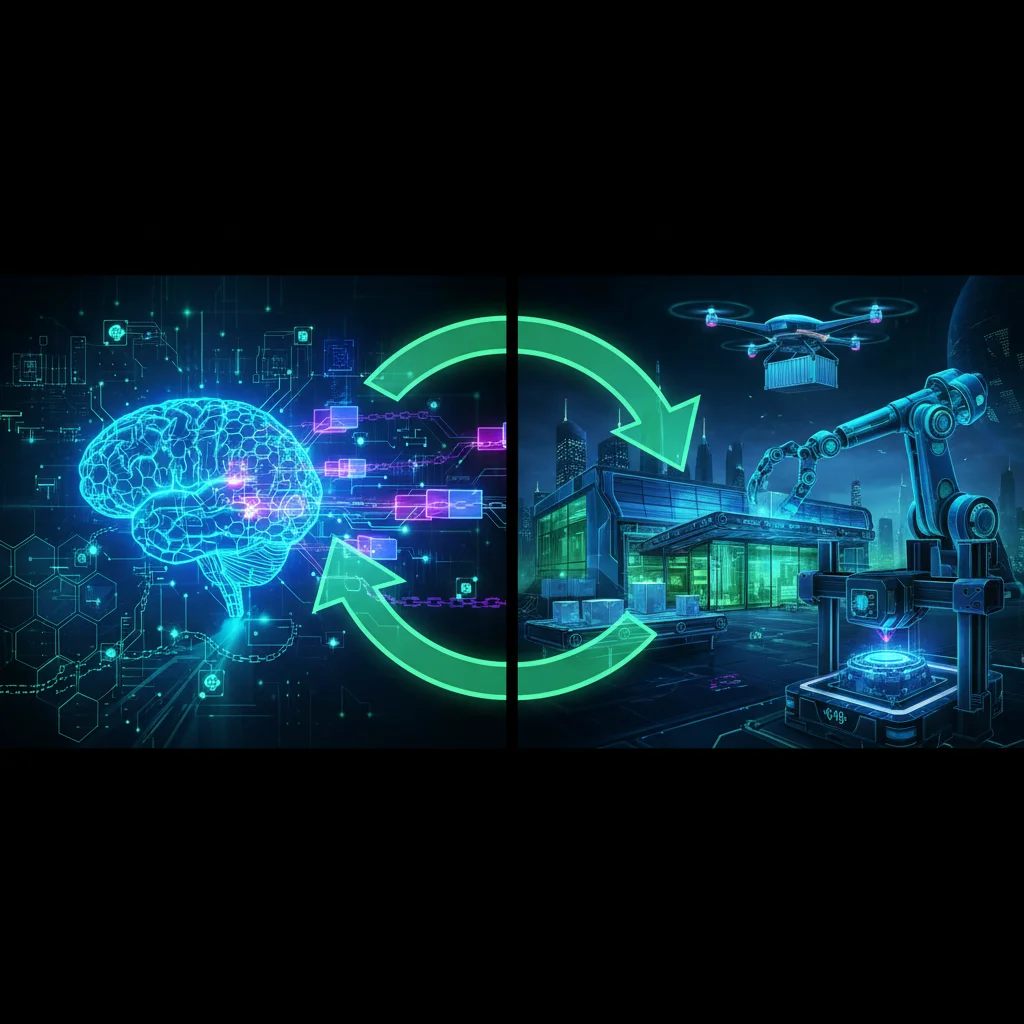
[IMAGE: A futuristic split-screen illustration of a global supply chain network. Left side shows a glowing digital brain (AI) connected to a chain of blocks (blockchain), with IoT sensor nodes emitting data streams. Right side shows a robotic arm sorting boxes, a drone flying above a warehouse, and a 3D printer creating a part. In the background, a green circular arrow representing sustainability weaves through the scene. The style is high-tech, cyberpunk-inspired, with neon blues and greens.]